Sign in to unlock valuable content and features from our AI-driven platform. Receive timely technology updates and the latest information from the solution providers who can help you realize your goals.
Start your journey by entering your name and email address below:
Please confirm your email address!
We are going to send a confirmation email to your email address to let you receive timely technology updates and the latest information from the solution providers who can help you realize your goals.
Is this you? Please confirm your name and email address below to receive the requested information.
Please check this box to confirm that you are opting-in to receive communications from COR Concepts and the data sharing outlined in our privacy policy.
Initializing
Loading
TEI of Windows 365 and Azure Virtual Desktop
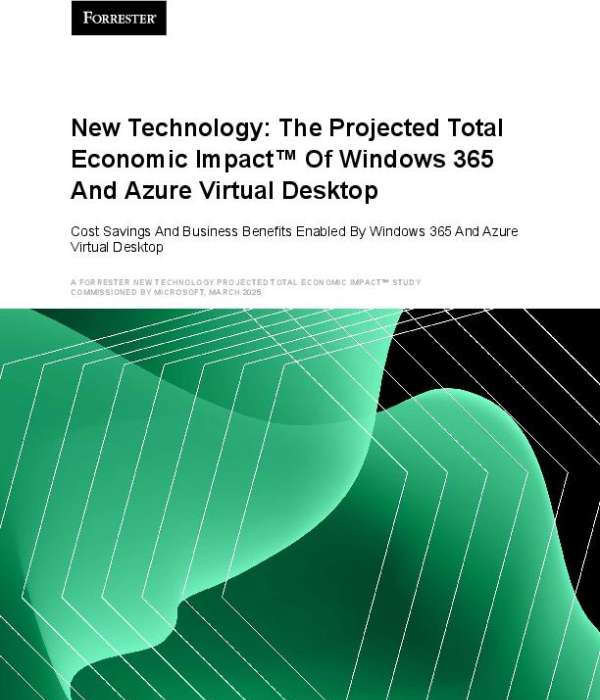
Organizations need reliable data to guide decisions about desktop virtualization. This Forrester Report, "The Projected Total Economic Impact™ of Windows 365 and Azure Virtual Desktop," offers insights into the financial and operational benefits you can achieve. Download the report to see the cost savings and increased productivity gains that come with these solutions. Contact COR Concepts to start the conversation about your virtualization strategy.
Please enter your information below to access this content:
What are the main benefits of using Windows 365 and Azure Virtual Desktop?
Organizations that implement Windows 365 and Azure Virtual Desktop can expect several benefits, including enhanced end-user productivity due to reduced latency and outages, significant savings on PC lifecycle management costs, and improved security through Microsoft-managed services. Over three years, the projected present value of productivity gains ranges from $3.1 million to $6.2 million, while savings from reduced PC lifecycle management costs can reach up to $1.2 million.
How does the pricing model differ between Windows 365 and Azure Virtual Desktop?
Windows 365 operates on a fixed per-user pricing model, which simplifies budgeting and eliminates concerns about fluctuating costs based on usage. In contrast, Azure Virtual Desktop uses a consumption-based pricing model, offering more flexibility and customization options but requiring organizations to manage their own Microsoft Azure subscriptions, which may involve more complex management and advanced technical skills.
What is the projected return on investment (ROI) for organizations using these solutions?
The projected return on investment (ROI) for organizations using Windows 365 and Azure Virtual Desktop varies based on impact scenarios. For a high-impact scenario, the ROI can reach 217% with a net present value (NPV) of $7.4 million. In medium-impact scenarios, the ROI is around 156% with an NPV of $5.3 million, while low-impact scenarios yield an ROI of 94% with an NPV of $3.2 million over three years.
TEI of Windows 365 and Azure Virtual Desktop
published by COR Concepts
COR Concepts provides Information Governance, Records Management and Enterprise Content Management (ECM) consulting and training services. The company is built on the belief that any Information, Records or Document Management initiative should be designed to extract the maximum business benefit for the organization.
We bring together Compliance, Risk Management and Operational information requirements in a way that delivers benefits to each one of these diverse business units. Our approach is to use an array of industry standards and best practice methodologies to ensure that each implementation will stand the test of time.
We see information governance and records management as an integral part of any Enterprise Content Management implementation and focus on building a solid platform including a records management policy, records management procedures, file plans and a solid change management infrastructure. Building and implementing governance structures is becoming essential for success and we design structures to ensure that all governance aspects are included.




 Sign in with LinkedIn